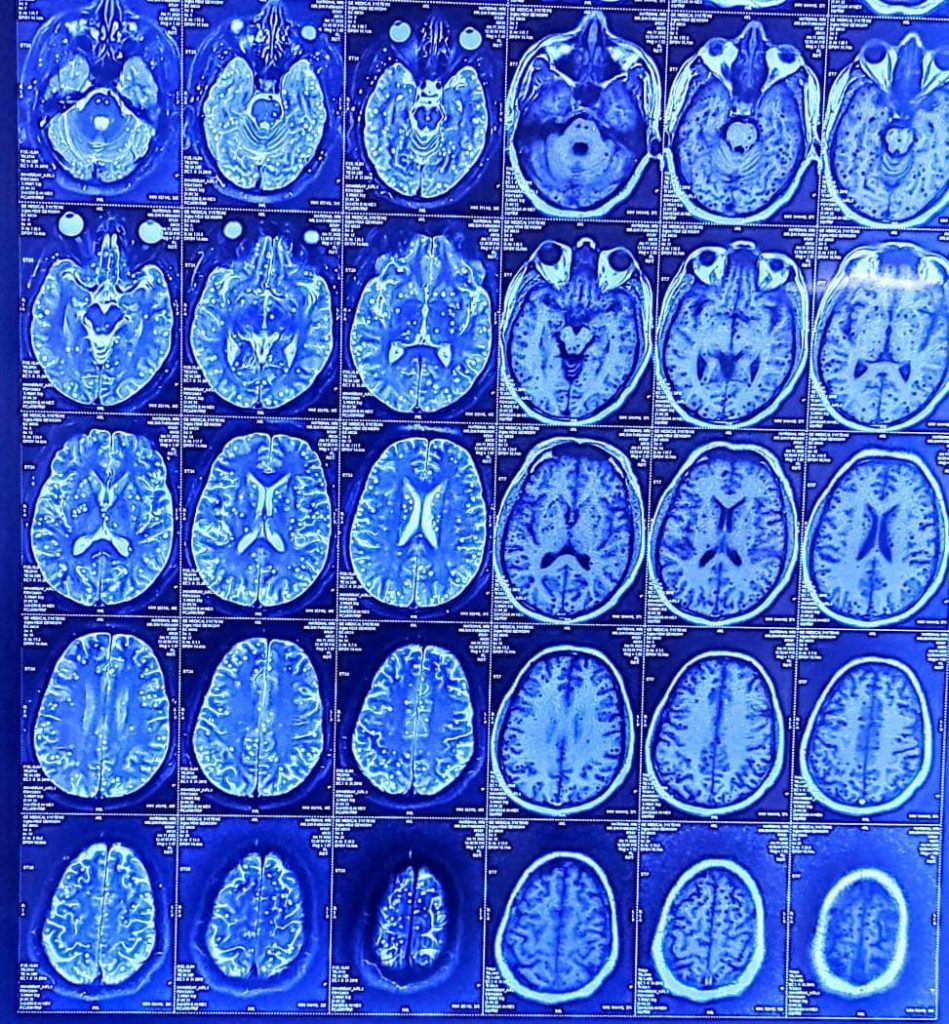
A 50 yr old right-handed, vegetarian, immunocompetent male was referred to emergency with a six month history of headache and seizures. He denied any B symptoms He had impaired memory and judgement without any focal neurological deficit. There was no organomegaly or lymphadenopathy. MRIbrain scan is shown below.
What is the Diagnosis?
Explaination:
Magnetic resonance imaging (MRI) brain with gadolinium contrast showed multiple cystic lesions with intracystic nodules suggestive of scolex.Its also know as Starry Sky Appearance.
Endemic in India, Neurocysticercosis (NCC) is perhaps one of the oldest known and perhaps the most common parasitic infections of the human nervous system. It is a major cause of epilepsy and neurological disease in many developing countries.The diagnosis is imaging based which shows characteristic “starry sky” appearance in heavy infestation cases
Explaination:
Magnetic resonance imaging (MRI) brain with gadolinium contrast showed multiple cystic lesions with intracystic nodules suggestive of scolex.Its also know as Starry Sky Appearance.
Endemic in India, Neurocysticercosis (NCC) is perhaps one of the oldest known and perhaps the most common parasitic infections of the human nervous system. It is a major cause of epilepsy and neurological disease in many developing countries.The diagnosis is imaging based which shows characteristic “starry sky” appearance in heavy infestation cases
Explaination:
Magnetic resonance imaging (MRI) brain with gadolinium contrast showed multiple cystic lesions with intracystic nodules suggestive of scolex.Its also know as Starry Sky Appearance.
Endemic in India, Neurocysticercosis (NCC) is perhaps one of the oldest known and perhaps the most common parasitic infections of the human nervous system. It is a major cause of epilepsy and neurological disease in many developing countries.The diagnosis is imaging based which shows characteristic “starry sky” appearance in heavy infestation cases